

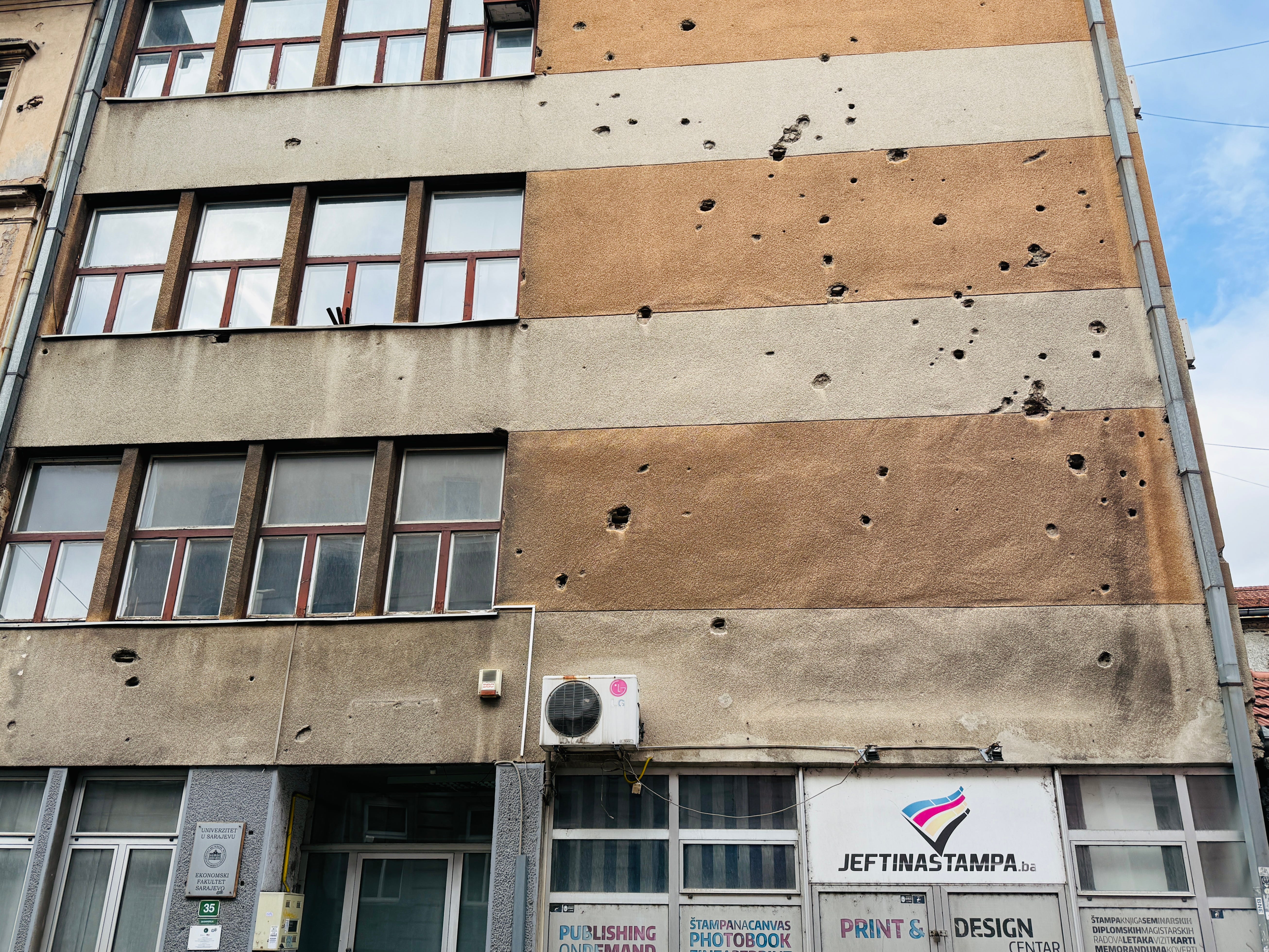
More than 30 years ago, on 14 December 1995, the Dayton Peace Agreement was signed.
What is that?
It was about ending the Bosnian War and defining how Bosnia and Herzegovina would function as a state afterwards.
What war?
The war in Bosnia and Herzegovina lasted from 1992 to 1995 and involved Bosniaks, Croats, and Serbs. It was marked by ethnic cleansing, sieges (like Sarajevo), and mass atrocities.
So the war has been over for a long time. But:
I am currently in Sarajevo, the capital of Bosnia and Herzegovina. The city was besieged for almost four years by Serbia and Bosnian Serbs. About 11,000 people died. Still, bullet holes can be seen in unrenovated houses, plaques with names and dates of birth and death commemorate the dead everywhere, and on the outskirts of the city, you can see destroyed and abandoned houses.
How did the war end?
In mid–1995, Bosnian government forces and Croat forces launched successful offensives, rolling back earlier Serb gains. At the same time, NATO carried out Operation Deliberate Force, a sustained air campaign against Bosnian Serb military targets. Together, these actions broke the stalemate and made continued fighting untenable. The mix of military pressure and intense international diplomacy culminated in the Dayton Peace Agreement.
How can a country live in peace when its people have been fighting and killing each other for years?
This is the question I‘ve been asking myself since I arrived here.
A clue:
The Dayton agreement froze the conflict. But daily life wasn‘t. Kids went to school. People needed jobs, buses, doctors, and coffee. Markets, weddings, funerals force contact. Maybe it is that simple. Over time, survival routines create a sense of functional peace, even when trust is thin.
What do I mean by „the conflict was frozen“?
Dayton made Bosnia and Herzegovina a single sovereign state divided into two entities—the Federation of Bosnia and Herzegovina and Republika Srpska—with a special self-governing Brčko District. Bosnia and Herzegovina has a three-member collective presidency (one Bosniak, one Croat, one Serb) and multiple layers of government designed to balance ethnic power. The system, created by the Dayton Peace Agreement, prioritises preventing renewed conflict but often results in political paralysis and ethnic vetoes.
So no progress?
There is. But it is slow. Progress in Bosnia and Herzegovina is called normalisation. Mixed cities function, economies interlink, people travel, marry, and work across ethnic lines—things like that. Plus: Younger generations are less invested in wartime identities, even if they inherit the system built around them.
The result:
No return to war. Three decades of peace matter more than they sound.
See you in Democracy.