

Friend of Democracy,
Which policies matter to supporters of which parties in Germany? What do centre-right voters of the ruling CDU party want? And what about those of the Social Democratic Party (SPD)? What are the priorities of supporters of the Alternative for Germany (AfD) party, parts of which are far-right?
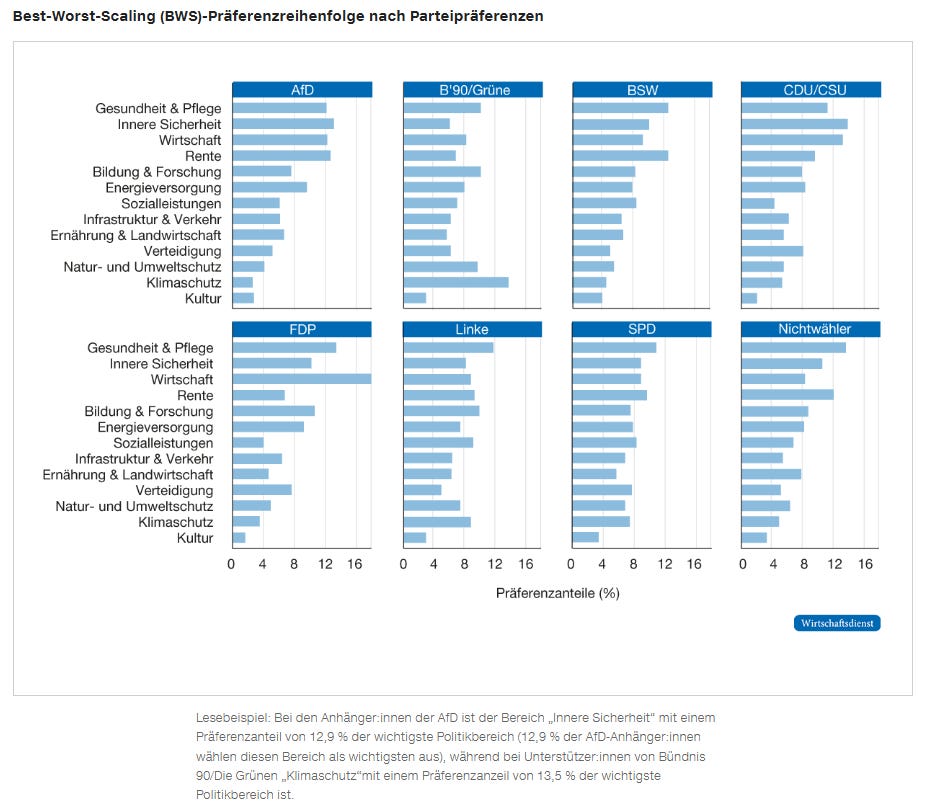
The economists Tobias Börger, Tim Lohse, Jürgen Meyerhoff, Salmai Qari and Andreas Stotland have investigated this question (paper available only in German) using a representative, survey-based choice experiment employing so-called best-worst scaling.
In this best-worst scaling method, participants are asked to repeatedly select what they consider to be the best and worst options from an experimentally generated list of alternatives. Consistent rankings can be derived from these repeated choices, enabling the quantification of relative preferences.
Participants could choose from 13 policy areas:
1 Education & Research (Bildung & Forschung)
2 Energy supply (Energieversorgung)
3 Food & Agriculture (Ernährung & Landwirtschaft)
4 Health & Care (Gesundheit & Pflege)
5 Infrastructure & Transport (Infrastruktur & Verkehr)
6 Home security (Innere Sicherheit)
7 Climate action (Klimaschutz)
8 Culture (Kultur)
9 Nature conservation and environmental protection (Natur- und Umweltschutz)
10 Pensions (Rente)
11 Social security benefits (Sozialleistungen)
12 Defence (Verteidigung)
13 Economy (Wirtschaft)
The results of the experiment are shown in the chart above.
Two key findings:
The importance citizens attach to different policy areas depends heavily on their party preference.
Policy areas that attract a great deal of public and media attention (such as defence and climate action) often do not feature prominently in the priority lists of individual voter groups.
The authors conclude:
“The analysis suggests that the government’s priorities do not necessarily align with the relative spending priorities of its own voter groups. This is particularly relevant where political strategies rely on significant shifts in resources or increases in spending, such as in the policy areas of defence and climate protection, which are considered of secondary importance by large sections of the electorate. Such discrepancies can heighten political disillusionment, weaken loyalty to established parties and thereby boost the appeal of opposition parties and, in particular, political fringe groups.”
So far for today.
See you in Democracy,
Johannes Eber